Setting Up an African Cichlid Tank: Water Chemistry and Aquascape
Tank size, hard alkaline water chemistry, crushed coral substrate, rockwork strategy, and stocking. The full African Mbuna setup playbook.
Getting an African cichlid tank right is one of the most rewarding projects in the fishkeeping hobby. When you nail the setup, the fish reward you with brilliant color and fascinating behavior, often breeding right in the main display.
But there’s a reason they have a reputation. A small mistake in water chemistry or rockwork can lead to a single, dominant bully and a very expensive problem.
Our team has set up hundreds of these tanks for homes and businesses. We’re going to walk through the exact playbook we use to ensure success, focusing on the popular and vibrant cichlids from Lake Malawi.
1. Pick a biotope first
Not all African cichlids are the same, and trying to mix them is a common first mistake. The two main groups you’ll see come from different lakes with different needs.
- Lake Malawi Mbuna. This group includes popular species like Yellow Labs, Acei, and Demasoni. They are rock-dwelling fish that need hard, alkaline water (pH 7.8 to 8.4) and a diet focused on vegetables.
- Lake Tanganyika. Here you’ll find Shell Dwellers (like Neolamprologus multifasciatus), Frontosas, and Julies. Their water needs to be even harder and more alkaline (pH 8.0 to 9.0). Their aquascape depends on the species, ranging from sand and shells to large rock piles.
You have to pick one biotope and stick with it. Mixing fish from these two lakes is a bad idea because their diets and aggression levels are incompatible. Mbuna are largely herbivores, while many Tanganyikan species are carnivores, creating immediate feeding problems.
For this guide, we’ll focus on a Malawi Mbuna setup, as it’s the most common and colorful starting point for a classic African cichlid tank.
2. Tank size
A 75-gallon tank is the absolute minimum for Mbuna. This isn’t a suggestion, it’s a requirement for long-term success. In smaller tanks, aggression is constant and deadly. A larger tank, from 90 to 125 gallons, provides enough space for fish to establish territories and for weaker fish to escape.
Tank shape is just as important as volume. You need a long tank, not a tall one. A standard 75-gallon tank (48” x 18” footprint) offers far more usable territory than a 65-gallon tall tank (36” x 18” footprint). That extra foot of length makes a huge difference in spreading out aggression.
3. Substrate and water chemistry
You must use a substrate that buffers your water, like crushed coral or aragonite sand. Products like CaribSea African Cichlid Mix are specifically designed to slowly release minerals that keep the pH high and the water hard. Do not use standard aquarium sand or gravel, as it is inert and won’t help you maintain the necessary water chemistry. Plan for a depth of about 1.5 inches.
Before you add anything, test your tap water. Here in Sarasota, our water is already moderately hard, typically reading:
- pH: 7.6 to 7.9
- KH: 6 to 10 dKH
- GH: 8 to 12 dGH
For Mbuna, you are aiming for these parameters:
- pH: 7.8 to 8.4
- KH (Carbonate Hardness): 10+ dKH
- GH (General Hardness): 12+ dGH
The aragonite substrate will do most of the work to get you into the right range. To perfect the mineral balance, we use Seachem Cichlid Lake Salt. This is not standard aquarium salt; it’s a blend of minerals like calcium, magnesium, and potassium that replicates the specific water of the African Rift Lakes. Follow the dosage on the package, which is typically one tablespoon per 10 gallons.

4. Rockwork
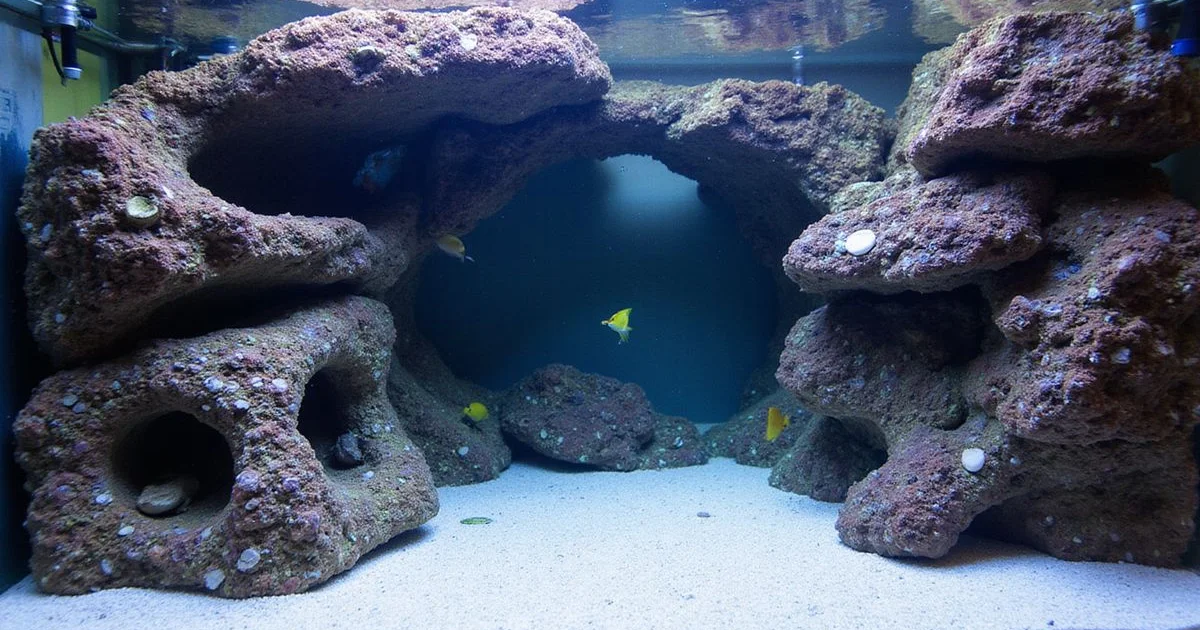
Mbuna are “rock-dwelling” cichlids, so creating a dense rock structure is essential. Stack rocks from the substrate up to the top of the tank against the back wall. This creates caves, territories, and crucial hiding spots that break lines of sight and reduce aggression.
Good rock choices include:
- Texas Holey Rock: This limestone is full of natural holes and crevices, perfect for cichlids.
- Lace Rock: It’s lightweight for its size and has a complex texture for creating interesting stacks.
- Slate: You can create stable caves by stacking flat pieces, but it requires more planning.
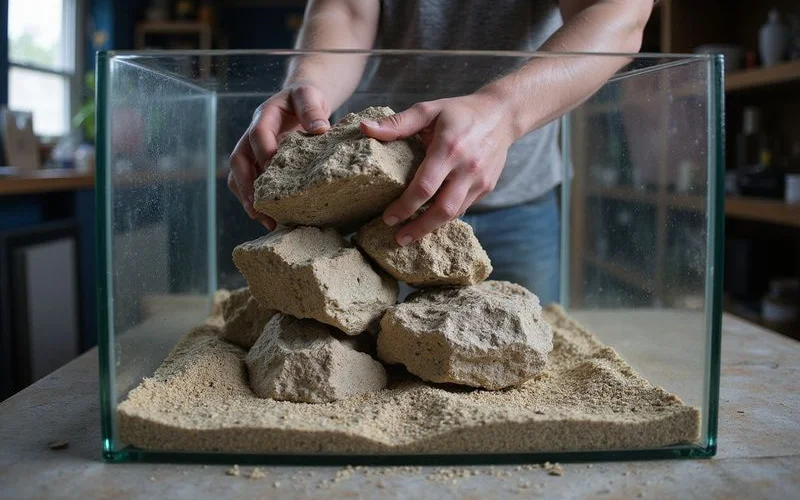
Always place the bottom rocks directly on the glass before adding sand. Cichlids love to dig, and if they burrow under a rock that’s sitting on sand, the whole structure can collapse and break the tank. For extra security, you can glue rocks together with an aquarium-safe silicone like ASI Aquarium Sealant. Make sure it’s 100% silicone with no mold inhibitors.
5. Filtration and flow
African cichlids are messy fish that produce a lot of waste, so you need heavy-duty filtration. Our rule of thumb is to have a filter system that turns over the total tank volume 8 to 10 times per hour. For a 75-gallon tank, that means you need a combined flow rate of 600-750 GPH.
You can achieve this with a few different combinations:
- One large canister filter like a Fluval 407 (383 GPH) paired with a large hang-on-back filter like an AquaClear 110.
- Two AquaClear 110 hang-on-back filters.
- A single, high-capacity canister filter like a Fluval FX4 or FX6.
In addition to filtration, Mbuna thrive in moving water. Add one or two powerheads, such as a Hydor Koralia or Sicce Voyager, to create a current that keeps waste suspended and provides enrichment for these active swimmers.
6. Stocking
With Mbuna, you need to stock the tank heavily. This strategy, often called “controlled overstocking,” sounds counterintuitive, but it’s the key to managing aggression. In a crowded tank, no single fish can establish a large territory and become a hyper-dominant bully. Aggression gets spread across many targets, so no one fish bears the brunt of the abuse.
For a 75-gallon tank, a good target is 15 to 20 adult Mbuna.
Mix 4 to 6 different species, buying 3 to 4 of each. It’s crucial to avoid species that look too similar, as the males will see each other as direct rivals and fight relentlessly.
Our go-to beginner-friendly Mbuna include:
- Yellow Lab (Labidochromis caeruleus): A bright, relatively peaceful species that adds a splash of solid yellow.
- Acei (Pseudotropheus acei): A calmer, schooling Mbuna that is blue with a distinctive yellow tail.
- Rusty (Iodotropheus sprengerae): A very hardy and tolerant species, making it great for those new to cichlids.
There are some fish we see sold to beginners that we strongly advise against. Melanochromis auratus (Auratus) and Metriaclima lombardoi (Kenyi) are notoriously aggressive. They have a “switch” that flips as they mature, often leading them to terrorize an entire tank. Wait until you have at least a year of Mbuna experience before trying them.
7. Cycle and add fish
You must cycle the tank completely before adding any fish. This is a non-negotiable step that establishes the beneficial bacteria needed to process fish waste. A fishless cycle typically takes 4 to 6 weeks. You can learn about the process in our guide to cycling your first freshwater tank.
To speed this process up, you can use a bottled bacteria product like FritzZyme TurboStart, which can establish a biofilter in as little as five days.
When your tank is cycled and ready, our cichlid stock is always quarantined for two weeks before we offer them for sale. We carry a wide variety of Mbuna and Tanganyikan species. If you bring in a photo of your setup, we can help you choose species that will thrive in the environment you’ve created.
If the aggression of Mbuna seems like too much, there are many other fascinating cichlids out there. You can explore some less aggressive options in our peaceful beginner cichlid picks.