Required Water Parameters for Healthy SPS
The seven parameters every SPS reefer tracks, target ranges, and what swings actually do to Acropora and Montipora.
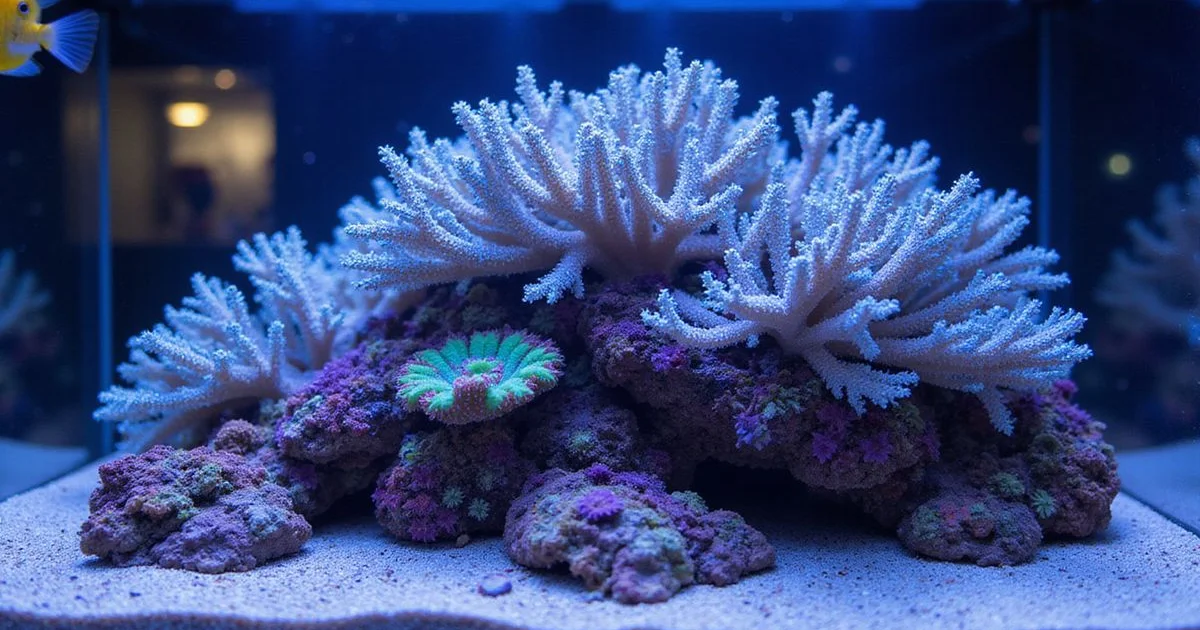
You know how keeping SPS corals, especially Acropora and Montipora, often feels like a balancing act on a razor’s edge. One day they’re vibrant and growing, and the next, a small parameter swing causes them to lose color or, even worse, crash completely.
Our team has found that the secret to stunning SPS isn’t chasing a “perfect” number, but achieving rock-solid stability. These corals reward consistency above all else. A tank that’s stable will always outperform one that swings, even if those swings pass through the ideal range.
That’s why we obsessively track seven key water parameters. Understanding and controlling these specific numbers is the foundation for the incredible growth and color that make these corals the pinnacle of the reefing hobby.
Let’s walk through the exact targets we use for our display reefs and the simple reasons why each one is so critical.
The seven required water parameters for healthy SPS
| Parameter | Target | Test frequency |
|---|---|---|
| Alkalinity | 7.5 to 9 dKH | Twice weekly |
| Calcium | 420 to 440 ppm | Twice weekly |
| Magnesium | 1300 to 1380 ppm | Weekly |
| Nitrate | 2 to 5 ppm | Weekly |
| Phosphate | 0.03 to 0.08 ppm | Weekly |
| Salinity | 1.025 SG | Weekly |
| Temperature | 78 to 80°F | Continuous |
Alkalinity: the most important number
Alkalinity is the measure of your seawater’s buffering capacity, which allows it to resist dangerous pH swings. For SPS corals, it’s the fuel for building their calcium carbonate skeletons.
Our Target: 7.5 to 9 dKH. We can’t stress this enough: Stability matters more than the specific number. A sudden drop of even 0.5 dKH can stress SPS corals. A tank held steady at 8.0 dKH will always be healthier than one that bounces between 8.5 and 9.5 over 24 hours.
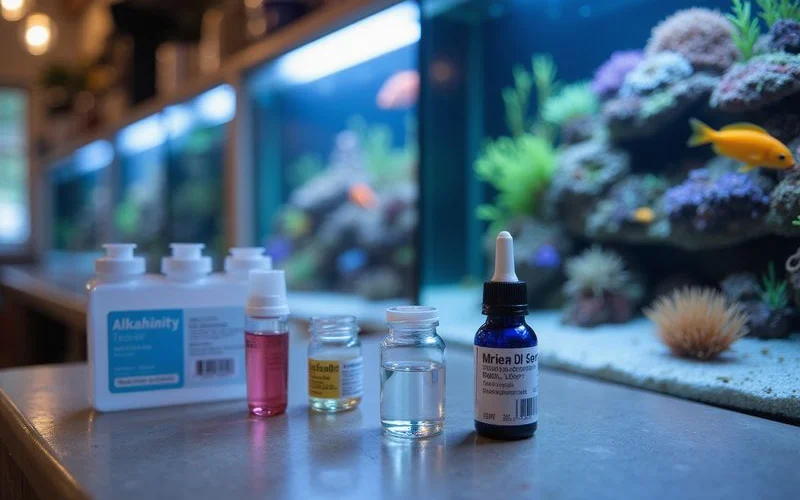
Testing: For daily checks, a simple Salifert test kit is reliable. For higher accuracy, we use the Hanna Instruments Alkalinity Checker (model HI772), which provides a digital readout and removes the guesswork of color-matching. For business owners with large display tanks, automated testers like the Neptune Systems Trident or the Reef Kinetics ReefBot can provide continuous monitoring and alerts.
Common Causes of Swings: The most common issues we see are empty two-part dosing containers or using a new salt mix for a water change that has a different alkalinity level than the old one.
Calcium: tracks alkalinity
Since coral skeletons are made of calcium carbonate, calcium is the other key ingredient for growth. Fast-growing SPS colonies consume it rapidly.
Our Target: 420 to 440 ppm.
Dosing: In our experience, calcium levels typically fall in tandem with alkalinity. A reliable two-part dosing system, like those from Bulk Reef Supply or ESV, is designed to replenish both elements in a balanced way, simplifying maintenance.
Magnesium: the buffer for the others
Think of magnesium as the mediator between calcium and alkalinity. It plays a crucial role by preventing calcium and carbonate ions from binding together prematurely and precipitating out of the water. Without proper magnesium levels, your calcium and alkalinity dosing becomes far less effective.
Our Target: 1300 to 1380 ppm.
Pro-Tip: If you’re struggling to keep alkalinity and calcium stable despite consistent dosing, check your magnesium. Low magnesium is an often-overlooked problem that can make the other parameters impossible to balance.
Nitrate: the new wisdom
The old-school advice for reef tanks was to aim for zero nitrates. We now know that’s a direct path to starving your SPS corals.
Today’s best practice is to maintain a small, detectable level of nitrate. This provides essential food for the symbiotic zooxanthellae living in the coral’s tissue, which in turn produces the deep, vibrant colors every reefer wants. A 2025 guide from Top Shelf Aquatics confirms that too little nitrate can starve corals, while too much can cause them to turn brown.
Our Target: 2 to 5 ppm. If levels creep above 10 ppm, we recommend proven nutrient control methods like carbon dosing with a product like Brightwell’s NO3:PO4-X or installing a refugium with Chaetomorpha algae.
Phosphate: same story
Similar to nitrate, phosphate is essential in trace amounts but problematic at high levels. The goal is detectable, but low.
Our Target: 0.03 to 0.08 ppm.
Testing: For accurately measuring such low phosphate levels, nothing beats the Hanna Ultra-Low Range Phosphate Checker (model HI736). Standard color-changing test kits are simply not precise enough at this range.
Running a system with zero nitrate and phosphate is a common cause of pale, browned-out, or stressed SPS corals.
Salinity: the easy one
This is one of the most fundamental parameters in a saltwater aquarium. Consistency is simple to achieve and non-negotiable for SPS health.
Our Target: 1.025 to 1.026 specific gravity at 78°F.
Testing: We exclusively use a refractometer for testing salinity. It’s important to calibrate it regularly, not with RO/DI water, but with a 35ppt salinity calibration fluid from a brand like Brightwell Aquatics or Bulk Reef Supply for an accurate reading. Avoid the cheap swing-arm hydrometers, as they are notoriously inaccurate.
Temperature: stability matters
SPS corals are sensitive to rapid temperature changes. Big swings are a major source of stress that can lead to bleaching.
Our Target: 78 to 80°F.
A daily fluctuation of more than 2°F is enough to stress your corals. We rely on a reliable aquarium controller, like a Neptune Systems Apex or a CoralVue Hydros, to monitor temperature continuously and send an alert to our phones if it ever drifts out of range. A pro-tip for larger systems is to use two smaller, controlled heaters instead of one large one as a failsafe against heater malfunction.
What our display reefs run
We believe in transparency, so our team logs parameters daily on a public board right on the wall. A typical reading on our main SPS display looks like this:
- Alk: 8.2 dKH
- Ca: 430 ppm
- Mg: 1340 ppm
- NO3: 3 ppm
- PO4: 0.05 ppm
- Salinity: 1.025 SG
- Temp: 79°F
These numbers have been held steady for over six months, and the health and coloration of the corals reflect that stability.
Dosing vs water changes
There are two primary ways to replenish the elements that SPS corals consume.
| Method | Best For | Pros | Cons |
|---|---|---|---|
| Two-Part Dosing | SPS-dominant tanks with moderate to high consumption. | Precise control, cost-effective at scale. | Requires initial setup and regular testing. |
| Water Changes | Low-stocked tanks or new systems. | Simple, replenishes trace elements. | Can become expensive and labor-intensive. |
For any tank with a significant number of SPS corals, automated two-part dosing of alkalinity and calcium is the standard practice. A 2022 analysis by reef chemist Randy Holmes-Farley found that maintaining parameters through water changes can be up to 19 times more expensive than using a two-part solution.
For tanks with extremely high demand, a calcium reactor is the next logical step, offering a more “set it and forget it” approach once dialed in.
When parameters swing
Your corals are the best indicators of a problem. If you see these symptoms, check your parameters immediately.
- STN at the base: Slow Tissue Necrosis, where tissue peels away from the base, is often a sign of a sudden alkalinity drop or chronically low calcium.
- Bleaching tips: The tips of the coral turning white can be caused by a temperature swing, an alkalinity spike, or too much light.
- Polyps not extending: This can be a symptom of many issues, but we recommend checking magnesium levels first if other parameters are in line.
- Brown coloration loss: When vibrant corals turn a dull brown, it typically points to excess nutrients (nitrate or phosphate). Conversely, a complete loss of color or paleness can indicate that nutrients are too low.
Knowing how to diagnose pests and diseases is another crucial skill. You can learn more in our guide to common coral pests and diseases. To understand the fundamental differences in care, our breakdown of SPS vs LPS vs soft corals is a great resource.
The health of our coral stock is a direct result of the stable parameters we maintain. When you get a frag from us, you can be confident it was grown in these exact, pristine conditions.